Ford Transit Van Upfits Built Around Your Work
Find the van. Organize the tools. Keep room for the job.
A useful Transit upfit starts with what your business carries and how your crew works. Shelving, drawers, partitions, flooring and ladder equipment should make that work easier without consuming the cargo space you still need.
Tell Frank about your trade, equipment and timing. We can help check Ford Transit vans on the ground at the dealership, compare suitable WEATHER GUARD layouts and coordinate the equipment and installation for your selected vehicle.
Serving Fort Myers, Lee County, Collier County and surrounding Southwest Florida communities.

What Is a Commercial Transit Upfit?
A Transit upfit adds equipment that turns the cargo area into a workspace for a particular business. A basic layout may combine a partition, shelving and floor protection. A more specialized build adds drawers, bins, ladder storage, work surfaces, power equipment or dedicated holders. The right scope depends on the work, not the number of accessories in a catalog photograph.
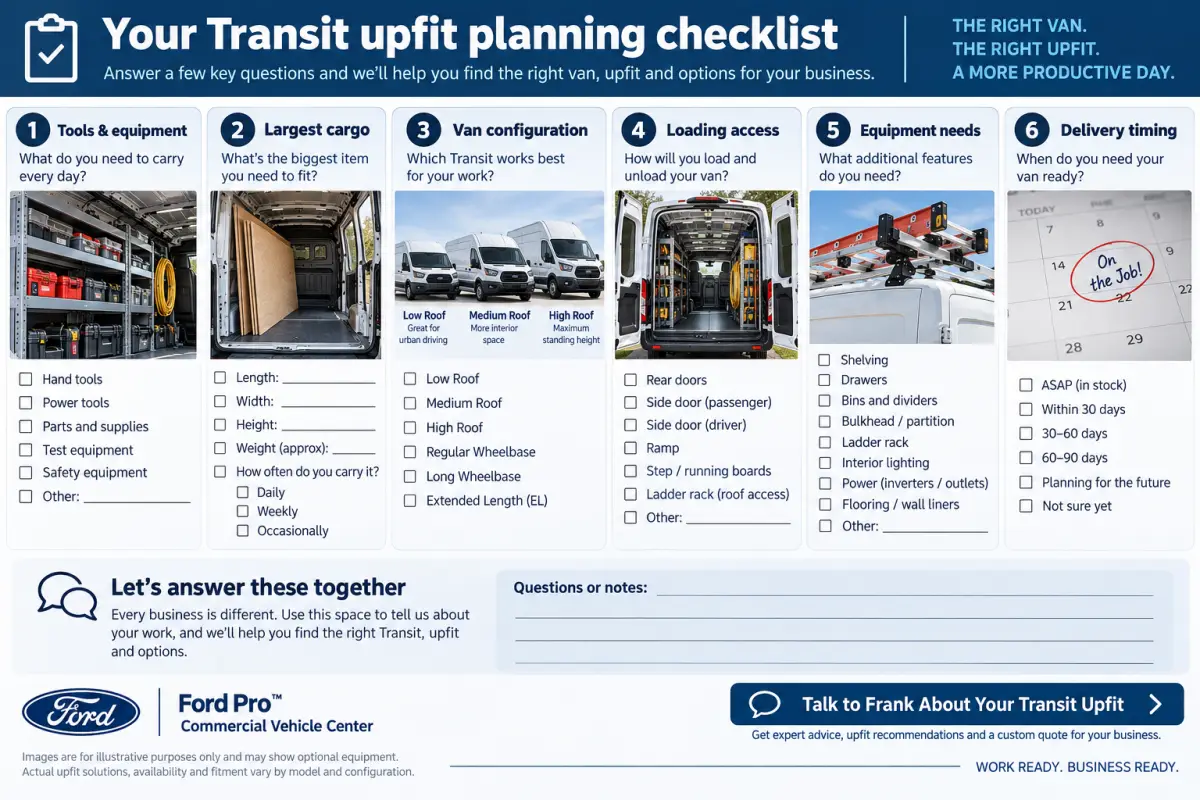
Use this guide to choose a starting layout, identify vehicle-fitment questions and prepare a useful quote request. You do not need every measurement before contacting us. A tool list, a description of your largest cargo and your ready-for-work date are enough to begin.
Build the Layout Around Your Daily Stops
Start with the normal service call
List the tools and parts used on most visits. Group items by task, then decide which should be reachable from the side door and which belong near the rear doors. A technician should not need to unload large cases just to retrieve a frequently used fitting.
Account for restocking as well as retrieval. Label bins consistently and leave room to recognize when supplies are running low.
Measure the largest occasional load
A layout that holds everyday tools can still fail on installation day. Measure replacement equipment, drain machines, carts, boxed products and anything that must pass through a door. Include handles, wheels and protective packaging.
Reserve a specific floor area for these loads. Check the route into that space, including door openings and the aisle left between cabinets.
Plan the return trip
Removed parts, packaging, wet equipment and returns need a place too. Keeping these items separate from clean stock helps preserve the organization you built into the van.
Describe the busiest realistic day rather than an empty-van demonstration. The layout needs to work when the shelves are stocked and larger equipment is aboard.

Which Transit Package Is the Best Starting Point?
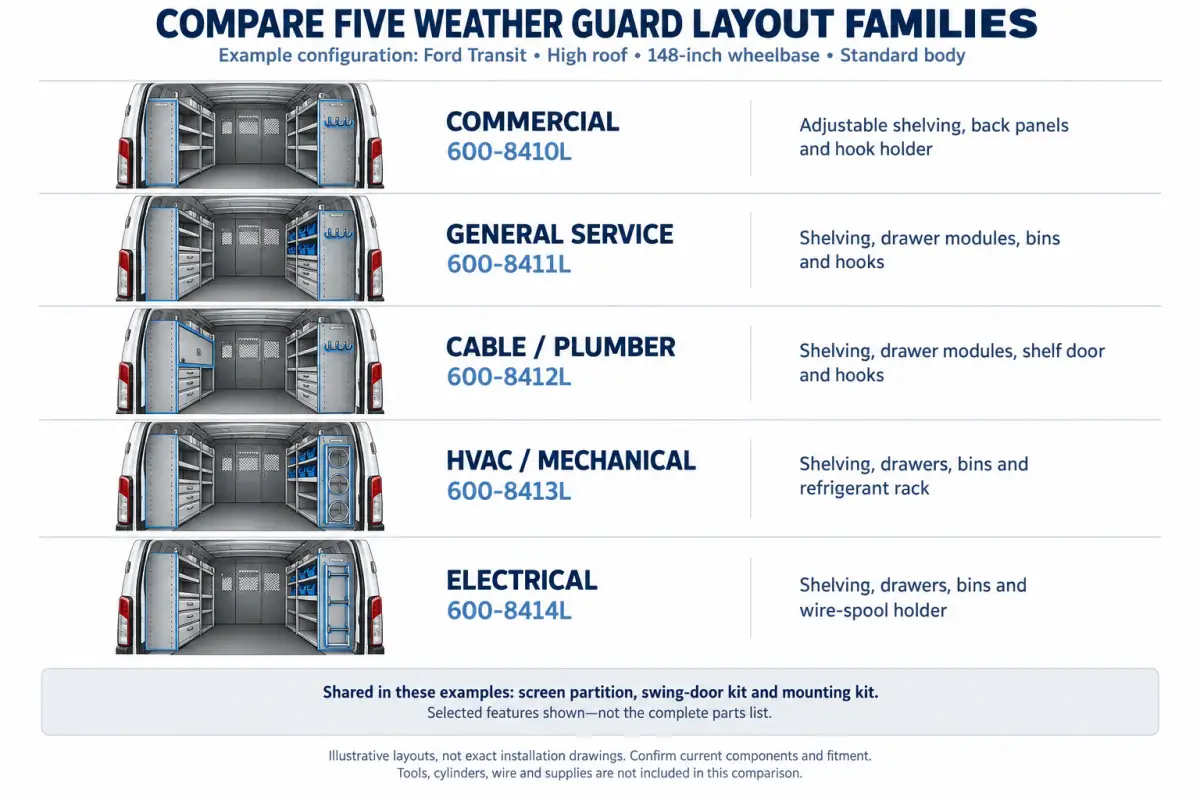
Choose a package family by the storage problem it solves, then confirm the version that fits the van. WEATHER GUARD offers commercial, general-service, cable/plumber, HVAC/mechanical and electrical layouts. Each is a starting specification that should be checked against your equipment list.
See WEATHER GUARD Transit package layouts by vehicle configuration at SWFL Upfit. For additions to an existing layout, compare individual shelves and van cabinets before confirming mounting space and fit.
The examples below refer to the catalog’s high-roof, 148-inch-wheelbase standard-body layouts. Other roof and body variants can use different components. These layouts may be assembled from individually purchased parts; a package number does not establish a complete boxed kit, installed price or dealership availability.
Commercial • 600-8410L
Start here for: organized general supplies and straightforward shelf storage.
The reviewed layout uses adjustable shelving with back panels, a screen partition with a swing-door kit, mounting equipment and a hook holder. It provides a shelving foundation without assuming every business needs extensive drawers or trade-specific holders.
Review before choosing: whether loose parts need bins, whether valuable tools need enclosed storage, and how much floor space deliveries or equipment require.
General service • 600-8411L
Start here for: contractors and mobile maintenance crews carrying a varied tool inventory.
This layout adds a deeper shelf unit, two- and three-drawer modules, bins and hooks to the shelving arrangement. Drawers can separate tools from consumables while bins organize frequently replenished parts.
Review before choosing: case sizes, usable drawer dimensions, access with doors open and the amount of bulk stock that remains outside the cabinets.
Cable/plumber • 600-8412L
Start here for: service tools, fittings and a mix of small and larger plumbing equipment.
The reviewed layout combines shelving, two drawer modules, a shelf door and hook holders. Those components provide places for organized stock and tools, but do not automatically solve every pipe, cable or drain-machine storage need.
Review before choosing: long-material storage, wet equipment, the heaviest machine and its loading path. Explore plumbing layouts.
HVAC/mechanical • 600-8413L
Start here for: HVAC service tools, repair parts and equipment requiring dedicated storage.
The layout includes shelves, drawers, bins, a shelf door, a refrigerant rack, a literature holder and hooks. These create distinct storage locations rather than relying on open shelves for every item.
Review before choosing: actual cylinder compatibility, required restraints, recovery equipment and pump dimensions. Installation crews may need additional clear floor area. Explore HVAC layouts.
Electrical • 600-8414L
Start here for: organized electrical consumables, tools and wire storage.
The reviewed arrangement includes shelving, shelf doors, drawer modules, bins, a wire-spool holder and a literature holder. The additional divided storage helps separate connectors and small parts; the holder creates a dedicated location for compatible reels.
Review before choosing: reel sizes and weights, conduit length, protected test-equipment storage and access to larger cases. Explore electrical layouts.
What the package picture does not settle: tools, tanks and other contents shown in promotional images should not be assumed included. Confirm the component list, quantities, mounting hardware, partition arrangement and any separately proposed additions in the written quote.
Roof Height, Wheelbase and Body Length Matter
A package labeled Ford Transit does not fit every Transit configuration. Match the equipment to the roof, wheelbase, body length, doors and mounting requirements of the actual vehicle. If you already own the van, provide its VIN and configuration. If you are buying one, compare the van and upfit before committing to either.
Roof height changes more than headroom
Low-, medium- and high-roof layouts can require different shelving heights, partitions and attachment arrangements. Similar shelf dimensions do not prove that two packages interchange. The partition must suit the cab and roof, and the installation must follow the equipment manufacturer’s vehicle-specific instructions.
Think about how the crew works inside the van and where the finished vehicle parks. Roof equipment changes exterior clearance; interior flooring and other equipment affect usable space.
Wheelbase and body length are different
The catalog distinguishes 130-inch and 148-inch wheelbase applications, plus extended-body layouts. An extended body adds cargo length without making its model description a reliable substitute for actual wheelbase information.
Confirm standard versus extended body, shelf run lengths and remaining rear cargo space. Do not select equipment by a thumbnail, search filter or abbreviated package title alone.
Also identify door arrangements, existing interior trim, factory equipment and anything already installed. A cabinet that fits along the wall can still obstruct a door, a seat adjustment or access to vehicle service points. Transit Connect is a separate fitment; E-Transit installations also need their applicable instructions and vehicle-specific review.
Start with our Ford Transit vehicle guide, then let us compare the proposed upfit with the actual van. Where fitment is uncertain, supplier confirmation comes before an installation promise.

Build a Useful Interior Without Filling Every Inch
Shelves, bins and drawers
Shelves suit cases and larger supplies; divided bins suit replenished parts; drawers can organize hand tools and smaller equipment. Measure useful openings rather than exterior cabinet dimensions. Consider the clearance needed to pull a drawer out and lift a case from its shelf.
Leave room to change shelf spacing as the business evolves. Compare Transit shelving and cabinets and storage around your actual inventory.
Partitions and interior protection
A bulkhead separates the cab and cargo areas, but it does not replace proper equipment mounting and load securement. Review seat travel, access needs and the partition’s fit with adjacent storage. A pass-through opening is useful only if the full layout leaves it accessible.
Plan bulkheads, flooring and interior protection together so the proposed build accounts for their combined space and installation requirements.
Ladders and long materials
List ladder lengths, weights and how often they are unloaded. Compare loading methods, rack operation and finished roof clearance. Pipe and conduit storage need their own plan; an empty aisle is not automatically a suitable long-material restraint system.
Review Transit ladder racks before selecting a roof height or assuming a particular garage remains accessible.
Power and work surfaces need a defined job
Describe the equipment you want to run, how long it runs and whether it must operate with the van parked. Chargers, bench equipment and specialized machinery have different requirements. Have the installer review starting demands, wiring, protection, ventilation and appropriate mounting instead of choosing equipment from a generic wattage label.
A bench needs working clearance as well as floor space. Account for the operator, opened drawers and access to nearby equipment. If the van becomes a workshop, use the mobile service van guide to develop the storage, power and work-area plan together.

Payload, Equipment Weight and Cargo Access
The usable working load depends on the specific completed van. Installed shelving, partitions, flooring, racks and power equipment all contribute weight. So do occupants, tools, inventory and the cargo added during the day. A storage product’s load rating is not the van’s payload rating.
Build a realistic weight list before approving the layout. Include permanent equipment and a typical full stock load, then consider the heaviest foreseeable job. Discuss equipment placement and loaded axle weights with the installer when needed. A total that appears acceptable does not, by itself, show that every axle or component stays within its limit.
Keep an actual loading path
Check the narrowest point between shelves, the space behind the partition and the opening through the door you intend to use. Include the room needed to turn a cart or lift a machine. Door dimensions and interior floor dimensions answer different questions.
A useful demonstration is to map your largest equipment footprint onto the proposed layout, then check whether everyday tools remain reachable with that item aboard.
Check the complete configuration
Use the ratings and installation requirements for the selected van and equipment. If towing is part of the job, include the trailer’s effect on the loaded vehicle in the review. Do not borrow a maximum-capacity claim from a different engine, drivetrain or body configuration.
At handoff, review equipment operation, securement provisions, maintenance instructions and the responsibilities for the vehicle and upfit warranties.
Choose the Guide That Matches Your Business
A trade label is a starting point, not a finished equipment list. Two companies doing similar work can carry very different stock. These guides help narrow the questions before we compare a van and installation scope.
Service and installation trades
HVAC upfits focus on service parts, tools and specialized equipment while accounting for larger installation loads. Plumbing upfits address fittings, long materials and bulky machines. Electrical upfits organize connectors, wire, test equipment and tool cases.
Tell us whether one van handles both service and installation or whether separate crews need different layouts.
Mobile workshops
Locksmith upfits require a plan for parts, precision equipment and usable work surfaces. Mobile service vans combine storage with a defined work area and power requirements.
Consider what work happens inside the van, what happens outside, and whether a second person must move through the workspace during a call.
Delivery and specialized cargo
Delivery van upfits organize loads around stop sequence, returns and handling equipment. Refrigeration upfits need a separate assessment of product requirements, operating conditions, insulation and cooling equipment.
A general shelving package is not a substitute for a purpose-designed temperature-controlled build. Define the cargo and operating requirements before selecting the equipment.
How We Help You Get the Right Transit
1. Review vehicles on the ground
Tell us your must-have configuration and target date so we can check Ford Transit availability at the dealership. Separate essential requirements from preferences. If a different available van is suggested, compare its effect on the layout before accepting the substitution.
2. Define the equipment and installation
Confirm the proposed package or component list, vehicle fitment and any changes required for your tools. The written scope should distinguish included parts, optional equipment and installation work. Supplier stock and installer scheduling are separate from the van’s availability.
3. Review the ready-for-work plan
Confirm the expected completion date for the actual build and how the finished layout will be checked. Review doors, drawers, access, electrical equipment and remaining cargo space. Clarify who supports each part of the completed vehicle after delivery.
What affects the installed price?
The total depends on the van, storage components, partition, flooring, rack equipment, power needs and installation scope. A shelving-only price should not be compared with a complete installed package. Ask whether mounting kits, hardware, finishing work and selected accessories are included, and identify charges outside the quoted scope.
When comparing two proposals, line up equivalent equipment and quantities. A lower initial price may reflect fewer drawers, different shelf dimensions or omitted installation work. Conversely, a larger package is not automatically better if it occupies space your crew needs for equipment.
We can help with upfit coordination and explain the next steps for an available van. If current stock does not fit a future fleet requirement, FleetOrdering.com provides a starting point for factory-order and future-order planning.
What to Send Before Your Transit Upfit Consultation
- Your business and workflow: trade, number of technicians, typical stops and whether you do service, installation or deliveries.
- Your vehicle: whether you need a van or already own one, plus VIN, roof height, wheelbase and standard or extended body if known.
- Your tool and stock list: cases, machines, bins, reels, cylinders and quantities carried on a busy day.
- Your largest load: dimensions, weight, handling equipment and the door used for loading.
- Your equipment priorities: drawers, partition access, ladders, power, workbench and anything that must remain mounted.
- Your purchase plan: quantity, budget range, target date and parking or clearance restrictions.
If you are unsure about the package family, say so. We can begin with the work you need to perform and narrow the equipment choices. A clear list of requirements is more useful than a package number chosen before fitment has been checked.
For multiple vans, develop a repeatable storage plan and document the component list. Standardize common tools and bin locations where practical, while allowing different layouts for service and installation crews. That gives future replacement decisions a useful starting point without assuming every employee carries the same equipment.
Frequently Asked Questions
Can you help me find an available Ford Transit and have it upfitted?
Yes. Tell us about your business, equipment and timing so we can check dealership vehicle availability and review a suitable upfit. A van on the ground may still need equipment sourcing and installation. We will distinguish vehicle availability from a completed, ready-for-work configuration.
Which WEATHER GUARD package should I choose?
Start with your storage needs. Commercial layouts provide a shelving base; general-service layouts add more tool and parts organization; plumbing, HVAC and electrical layouts introduce trade-oriented components. Confirm the specific vehicle version and compare its component list with your actual tools before selecting.
Is a package number a complete installed kit?
Do not assume that it is. The reviewed package layouts may be assembled from individually purchased components. Ask for the current parts list, quantities, mounting hardware and installation scope. Tools and equipment pictured in a catalog are not automatically included in the purchase.
Does every package fit every roof height and Transit body length?
No. Roof height, wheelbase, standard or extended body, door arrangement and mounting requirements affect fitment. Similar shelves do not make partitions or installation hardware interchangeable. We can help identify the configuration and obtain the appropriate supplier confirmation.
Can you help if I already own a Transit?
Contact us with the VIN, configuration, existing equipment and what you want to change. We can review the request and discuss coordination options. Compatibility and installation scope must be assessed before promising that an existing interior can accept a particular package or component.
How much cargo space will remain after shelving is installed?
That depends on shelf depth, cabinet placement, partition position and your van. Measure the clear aisle, door openings and the floor area reserved for larger loads. Check whether your equipment can turn and move through that space, rather than relying only on the van’s published cargo volume.
How does an upfit affect payload?
Installed equipment adds weight and reduces the capacity remaining for occupants, tools and cargo within the vehicle’s limits. Review the specific completed configuration and its applicable total and axle ratings. A shelf rating or advertised maximum for another Transit does not establish your van’s working capacity.
Can I add ladders, power equipment and a workbench?
These can be considered as part of the complete layout. Define ladder sizes, electrical loads, operating time and work-surface needs first. The installer must review mounting, clearances and vehicle compatibility. Each addition also affects weight and the space available for cargo.
Can an HVAC package carry any refrigerant cylinder?
No universal fit should be assumed. Match the actual cylinders to the proposed rack and review suitable restraints and installation requirements. A package photograph or rack name does not establish compatibility with every cylinder or confirm all transport requirements.
How long does a Transit upfit take?
Timing depends on the selected van, component availability, installation scope and the installer’s schedule. Give us your required ready-for-work date early. Confirm the completion plan for the actual build instead of relying on a generic installation-time estimate.
What if my fleet needs vehicles for a later replacement cycle?
We can help separate immediate vehicle needs from future requirements. Document the desired van configuration, equipment list and quantities so the next conversation is specific. Factory ordering and future fleet planning can be explored through FleetOrdering.com when available stock is not the appropriate route.
What should I check before taking delivery?
Review access to tools and cargo, door and drawer operation, equipment mounting and the agreed installation scope. Obtain operating and maintenance instructions and clarify vehicle, equipment and installation warranty responsibilities. Confirm that the completed configuration is suitable for the working load you described.
Tell Frank What Your Transit Needs to Do
Need an available Ford Transit, a commercial storage package or help putting the two together? Share the job you need the van to perform. We will help narrow the vehicle, equipment and next steps.
In the message field, include your trade, largest tools or cargo, roof and body configuration if known, vehicle quantity and target date. If you already own a van, mention that too. You do not need a package model number to start.
Call 239-274-2405 or email frank@commercialfleetvehicles.com.
Start With the Work. Build the Right Transit.
Let’s check available vans and plan useful equipment around your crew, cargo and schedule.
Compare Ford Transit vehicle options or explore all work-truck bodies and van upfits.