Ford F-600 Commercial Trucks for Southwest Florida Businesses
The Ford F-600 gives businesses additional chassis capability while retaining the familiar size and packaging of a Super Duty commercial truck.
With a 22,000-lb. maximum GVWR, multiple wheelbase and cab-to-axle configurations, gas or diesel power, and 4×2 or 4×4 availability, the F-600 can become the foundation for demanding commercial upfits.
When an F-550 Is Not Quite Enough
The F-600 fills an important position in Ford’s commercial truck lineup. It provides additional chassis capacity for businesses whose completed work truck may exceed what makes sense on an F-550, without immediately moving into a larger F-650 medium-duty truck.
Up to 22,000 lbs. GVWR
The F-600 provides a maximum GVWR of 22,000 pounds when properly equipped, creating additional capacity for heavier bodies, equipment and payload.
Built for an Upfit
The chassis is designed to become a completed commercial vehicle with a body and equipment package selected around the work your business performs.
Four CA Choices
Current F-600 configurations provide 60″, 84″, 108″ and 120″ cab-to-axle dimensions for different body lengths and applications.
Match the Work Environment
Choose between 4×2 and 4×4 configurations depending on operating conditions, jobsites and the requirements of the completed truck.
The Numbers That Matter When Planning an F-600
These figures are based on Ford’s current F-600 commercial vehicle information and should always be verified for the exact vehicle being ordered.
22,000 lbs.
Maximum Gross Vehicle Weight Rating when properly equipped.
15,140 lbs.
Ford-listed maximum payload for a properly equipped gas F-600 configuration.
14,400 lbs.
Ford-listed maximum payload for a properly equipped diesel F-600 configuration.
43,500 lbs.
Maximum Gross Combined Weight Rating for the properly equipped diesel configuration.
Maximum ratings are independent attributes and may not be achievable simultaneously. Actual payload and towing capability depend on the exact chassis, options, body, equipment, passengers and cargo.
The F-600 Is Built Around a Regular Cab
Unlike the F-550, which offers additional cab configurations, the current F-600 lineup is built around a Regular Cab commercial chassis.
That makes the F-600 especially focused on applications where maximizing chassis capacity and commercial body space is more important than transporting a large crew inside the cab.
Businesses needing additional seating should consider whether an F-550 SuperCab or Crew Cab configuration better fits the application before moving into an F-600.
Regular Cab
The current Ford F-600 is offered as a Regular Cab dual-rear-wheel commercial chassis.
✓ Regular Cab
✓ Dual Rear Wheels
✓ 4×2 available
✓ 4×4 available
F-600 Wheelbase & Cab-to-Axle Options
Ford currently offers four F-600 Regular Cab chassis lengths. Each one has a different cab-to-axle dimension, giving an upfitter different amounts of chassis space behind the cab.
| Cab | Wheelbase | Cab-to-Axle | Drive | Planning Use |
|---|---|---|---|---|
| Regular Cab | 145.3″ | 60″ CA | 4×2 or 4×4 DRW | More compact commercial bodies where overall length and maneuverability are priorities. |
| Regular Cab | 169.3″ | 84″ CA | 4×2 or 4×4 DRW | Additional chassis space for larger service, contractor, flatbed and dump applications. |
| Regular Cab | 193.3″ | 108″ CA | 4×2 or 4×4 DRW | Longer bodies, equipment-heavy builds and specialized commercial applications. |
| Regular Cab | 205.3″ | 120″ CA | 4×2 or 4×4 DRW | Long commercial bodies and specialized builds requiring substantial chassis space behind the cab. |
Current dimensions reflect Ford’s 2026 F-600 chassis configuration information. Specifications and availability can change. Always verify the exact chassis against the intended body manufacturer’s requirements before ordering or beginning an upfit.
The F-600 CA Should Match the Body
Cab-to-axle, or CA, is the distance from the back of the cab to the centerline of the rear axle.
It is one of the most important measurements when building an F-600 because the body manufacturer designs commercial bodies around specific chassis dimensions.
A truck with a 60-inch CA and one with a 120-inch CA are both F-600s, but they can be intended for very different completed vehicles.
Chassis + Body + Equipment + Payload
✓ Body length and weight
✓ Tool and equipment weight
✓ Cargo or material payload
✓ Equipment placement
✓ Front and rear axle loading
✓ Finished vehicle operating weight
Which F-600 Configuration Fits the Job?
The examples below show why Ford offers multiple cab-to-axle lengths. Final body compatibility must still be determined by the upfitter.
Compact Heavy-Duty Builds
Useful when the business needs F-600 chassis capacity but wants to keep the completed vehicle comparatively compact.
Potential applications can include appropriately sized service, utility and equipment bodies.
Versatile Work-Truck Builds
The additional space can support larger commercial bodies and more equipment while maintaining a relatively manageable overall truck length.
This can be useful for service, contractor, flatbed and dump applications.
Longer Equipment Bodies
The 108-inch CA gives builders significantly more chassis space for bodies carrying substantial equipment, storage or material.
It can make sense for larger mechanics, service, platform and specialized commercial builds.
Long Specialized Builds
The longest current F-600 configuration is intended for applications where significant chassis length is required behind the cab.
These projects should be planned closely with the body manufacturer before the chassis is ordered.
7.3L Gas or 6.7L Power Stroke Diesel?
Ford currently offers both gas and diesel power for the F-600. The right choice depends on how the completed truck will work throughout its service life.
7.3L V8 Gas
335 horsepower
468 lb-ft of torque
A gas F-600 can make sense for businesses considering acquisition cost, annual mileage, maintenance, idle time and daily operating patterns.
Ford currently lists a maximum payload of up to 15,140 pounds for a properly equipped F-600 gas configuration.
6.7L Power Stroke V8 Diesel
330 horsepower
950 lb-ft of torque
Diesel can be particularly useful where the completed truck will see demanding towing, high utilization, substantial loads or commercial duty cycles that benefit from diesel torque.
Ford currently lists a maximum payload of up to 14,400 pounds for a properly equipped diesel F-600 configuration.
The Diesel F-600 Can Support Serious Trailer Work
Trailer capability varies by engine, drivetrain, wheelbase, body and completed vehicle configuration.
Up to 43,500 lbs.
Ford lists a maximum GCWR of 43,500 pounds for properly equipped 6.7L diesel F-600 configurations.
Up to 34,600 lbs.
Ford’s current chassis cab towing guide lists maximum fifth-wheel trailer capacity of up to 34,600 pounds on a properly configured diesel F-600.
Up to 34,700 lbs.
Ford lists maximum gooseneck towing of up to 34,700 pounds when properly equipped.
Maximum towing varies by cargo, body, vehicle configuration, accessories and passengers. Never select an F-600 based only on a maximum published towing number.
Where the Extra Chassis Capacity Can Matter
The F-600 becomes especially valuable when the commercial body, equipment and payload begin consuming more of the completed vehicle’s available capacity.
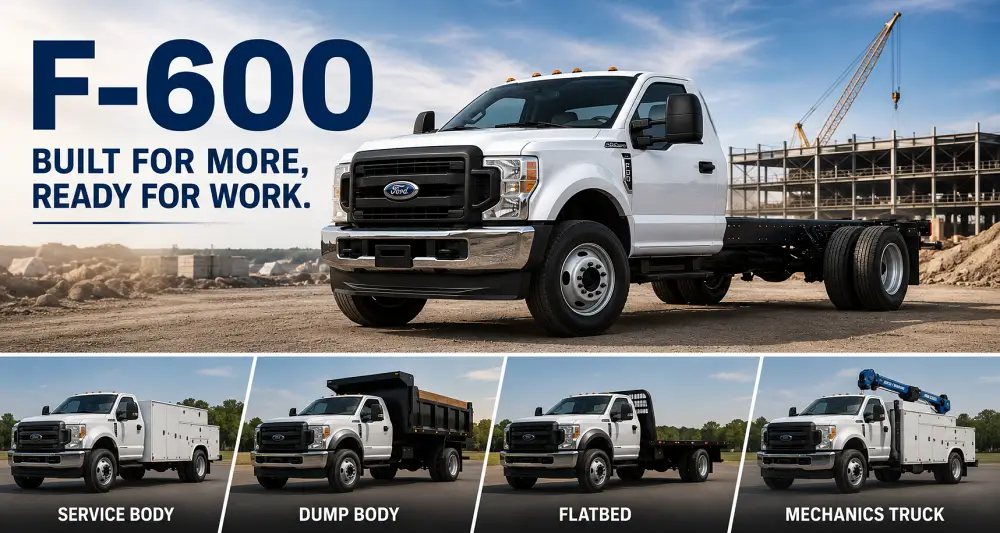
Heavy Service Body
Larger service bodies can carry extensive tools, replacement parts and equipment.
The F-600 can be worth considering when the body and loaded compartments make an F-550 configuration less desirable for the finished truck.
Explore Service Bodies → HEAVY EQUIPMENTCrane Body
Cranes, stabilizers, reinforced bodies, compressors and tools can add substantial weight before cargo is loaded.
Chassis capacity and axle loading should be planned with the crane and body manufacturer.
Explore Crane Bodies → MOBILE REPAIRMechanics Truck
Mechanics trucks may combine a service body, crane, compressor, welder, fluids, tools and replacement components on one chassis.
That makes completed-vehicle weight an important part of deciding between an F-550 and F-600.
Explore Mechanics Trucks → MATERIAL HAULINGDump Body
The truck must account for the dump body, hydraulic equipment and the material being transported.
The F-600 can provide useful additional capacity for properly designed heavier dump applications.
Explore Dump Bodies → EQUIPMENT & MATERIALFlatbed
Flatbeds can transport pallets, building supplies, equipment and irregular cargo.
Wheelbase, deck length and expected payload should be planned together before selecting the chassis.
Explore Flatbeds → LANDSCAPE OPERATIONSLandscape Dump
Landscape trucks may carry equipment, debris, mulch, soil and other bulk materials while also towing equipment trailers.
Chassis capacity becomes increasingly important as the body and material load increase.
Explore Landscape Dumps →More Ways to Build an F-600
Contractor Body
Tool storage and open cargo space for demanding construction applications.
Platform Body
Open commercial deck space for equipment and material.
Stake Bed
Versatile material hauling with configurable or removable sides.
Utility Body
Equipment storage and field support for utility operations.
Welder Body
Mobile welding equipment, power and field-service storage.
Towing & Recovery
Specialized configurations designed around recovery equipment and intended operating weight.
Forestry Body
Specialized equipment configurations for forestry and vegetation-management work.
More Upfits
Explore commercial bodies and equipment for additional work-truck applications.
View All Upfits →Payload Is More Than What You Put in the Truck
A commercial chassis starts using available carrying capacity as soon as the upfit is installed.
Commercial Body
Service bodies, dumps, flatbeds and crane bodies all contribute to completed vehicle weight.
Installed Equipment
Cranes, compressors, welders, tanks, liftgates and storage systems consume additional capacity.
Tools & Cargo
Tools, replacement parts, equipment and materials carried during daily operations add more weight.
People & Trailer Load
Occupants and trailer tongue or hitch loads must also be considered when evaluating the completed truck.
F-550 vs. F-600 vs. F-650
Moving to the larger model is not automatically the right answer. The goal is to select enough chassis for the completed vehicle without unnecessarily moving into a larger class of truck.
Ford F-550
The F-550 can make sense when its available GVWR and axle ratings support the completed body, equipment and payload.
It also offers more cab choices when SuperCab or Crew Cab seating is needed.
Explore F-550 →Ford F-600
The F-600 provides up to 22,000 pounds of GVWR while remaining within Ford’s Super Duty chassis cab family.
It can be especially useful for heavier upfits where an F-550 may not provide the desired completed vehicle capacity.
Ford F-650
The F-650 moves the business into Ford’s larger medium-duty platform with additional chassis, wheelbase and commercial body possibilities.
Explore F-650 →F-600 4×2 or F-600 4×4?
F-600 4×2
4×2 may make sense when the truck primarily operates on paved roads, developed properties and predictable commercial routes.
Application, body weight, expected payload and operating environment should still be considered.
F-600 4×4
4×4 may make sense for construction sites, utility work, landscaping, undeveloped properties and other environments where additional traction can be useful.
Upfit height, loading requirements and intended use should be reviewed when selecting 4×4.
Start With the Body You Need
F-600 inventory is configuration-specific. Before buying an available chassis, make sure its wheelbase, CA, drivetrain, engine and equipment work with the intended upfit.
Find an Available F-600
Tell us what type of body or completed truck you need and we can help identify an available F-600 chassis that may fit the project.
We can review the configuration before you commit to a chassis that may not work with the intended body.
Order the F-600 Around the Upfit
Factory ordering may make sense when the business needs a particular wheelbase, CA, drivetrain, engine or equipment configuration.
For commercial chassis trucks, ordering the vehicle around the planned body can prevent costly configuration problems later.
Built for Businesses Carrying Serious Equipment
Construction
Dump bodies, flatbeds, contractor bodies and equipment trucks.
Landscaping
Landscape dumps, material trucks and equipment hauling.
Tree Service
Specialized bodies, equipment and demanding field operations.
Utility & Electrical
Utility bodies, equipment and specialized service trucks.
Government
Public works, road maintenance and municipal fleet applications.
Fleet Operations
Standardized work-truck configurations and replacement planning.
More Industries
Explore additional commercial truck applications.
View Industries →Plan the Complete F-600 Before You Buy the Chassis
A successful commercial build starts by looking at the entire truck rather than treating the chassis and body as separate purchases.
Job Requirements
Determine what employees need the completed truck to carry, tow and accomplish.
Body Selection
Identify the body size, equipment and approximate completed weight.
Chassis Selection
Match wheelbase, CA, engine and drivetrain to the body and application.
Fleet Standardization
Document successful configurations so future trucks can be ordered around a proven specification.
Ford F-600 Commercial Truck Support in Southwest Florida
We help businesses determine the right F-600 chassis, plan commercial bodies and source or factory order trucks for demanding work applications.
Build the Right F-600 for Your Business
Tell us what the completed truck needs to do, what body or equipment you plan to install and how much material or equipment it will normally carry.
We can help review wheelbase, cab-to-axle length, gas vs. diesel, 4×2 vs. 4×4, available chassis, upfit coordination and factory-order options.
Prefer to talk? Call 239-274-2405
Ford F-600 Commercial Truck Questions
What is a Ford F-600?
The Ford F-600 is a Super Duty commercial chassis cab designed for businesses that need greater chassis capability than an F-550 may provide for the intended completed vehicle.
What is the GVWR of an F-600?
Ford currently lists a maximum GVWR of 22,000 pounds for the F-600 when properly equipped.
Does the F-600 come in Crew Cab?
The current F-600 chassis cab is offered as a Regular Cab. Businesses that need SuperCab or Crew Cab seating should compare F-550 chassis configurations.
What F-600 wheelbases are available?
Ford currently lists F-600 Regular Cab wheelbases of 145.3, 169.3, 193.3 and 205.3 inches.
What F-600 cab-to-axle lengths are available?
Current F-600 configurations include approximately 60, 84, 108 and 120-inch cab-to-axle dimensions, depending on wheelbase.
Is the Ford F-600 available in 4×4?
Yes. Ford currently lists both 4×2 and 4×4 dual-rear-wheel F-600 chassis configurations.
What engines are available in the F-600?
Ford currently offers the F-600 with a 7.3L V8 gas engine or a 6.7L Power Stroke V8 diesel engine. Current Ford specifications list the gas engine at 335 horsepower and 468 lb-ft of torque and the diesel at 330 horsepower and 950 lb-ft of torque.
Why choose an F-600 instead of an F-550?
An F-600 may make sense when the commercial body, permanently installed equipment, cargo and intended workload require more completed-vehicle capacity than the desired F-550 configuration provides. The complete vehicle should be evaluated before making the decision.
What bodies can be installed on an F-600?
Depending on the exact chassis and body manufacturer’s requirements, F-600 applications can include service bodies, mechanics bodies, crane bodies, dumps, landscape bodies, flatbeds, contractor bodies, utility bodies and other specialized commercial upfits.
Can I factory order an F-600?
Factory ordering may be available when a business needs a specific wheelbase, cab-to-axle dimension, drivetrain, engine or equipment configuration. Order-bank availability and production schedules can change.
Explore Related Ford Commercial Chassis
Ford F-550
Compare the F-550 before moving to the heavier F-600 chassis.
Explore F-550 →Ford F-650
Move into Ford medium-duty capability for larger commercial applications.
Explore F-650 →Ford Chassis Cab
Compare Ford chassis cab platforms and commercial body options.
Compare Chassis Cabs →Ford Super Duty
Explore the broader Ford Super Duty commercial lineup.
Explore Super Duty →Choose the Body First. Then Match the Chassis.
Tell us what the finished F-600 needs to carry, tow and accomplish. We can help determine which wheelbase, cab-to-axle configuration, drivetrain and powertrain make sense for the upfit.