Ford Chassis Cab Commercial Trucks for Southwest Florida Businesses
Start with the right Ford chassis, then build the truck around the work your business actually needs to do.
Ford chassis cab trucks provide the foundation for service bodies, dump bodies, flatbeds, contractor bodies, crane trucks, landscape bodies and other specialized commercial upfits.
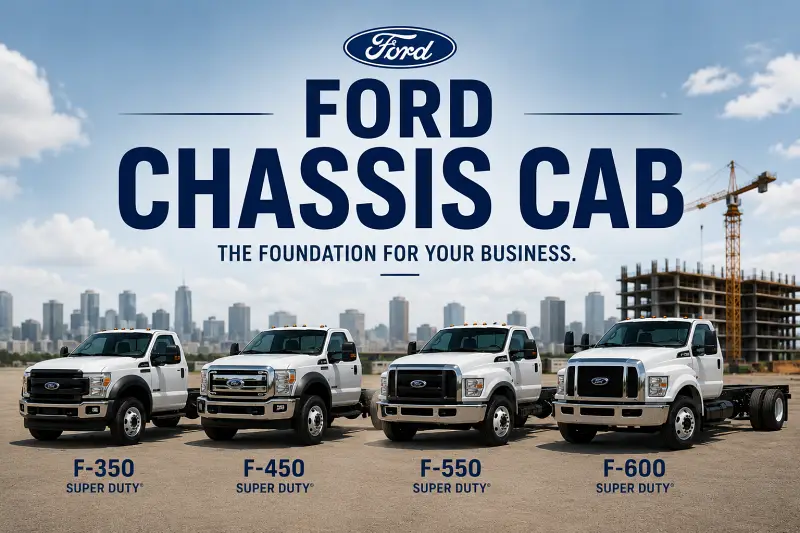
What Is a Ford Chassis Cab?
A chassis cab is a commercial truck supplied with the cab, frame, drivetrain and rear chassis rails ready for a commercial body to be installed.
Unlike a conventional pickup, a chassis cab is designed specifically to become a completed work truck.
That allows a business to choose a commercial body based on the work the vehicle needs to perform rather than adapting the job around a standard pickup bed.
The right chassis depends on much more than simply choosing between an F-350, F-450, F-550 or F-600. Cab configuration, wheelbase, cab-to-axle dimension, powertrain, payload requirements and the weight of the completed body all need to work together.
One Chassis. Many Different Work Trucks.
✓ Service and utility bodies
✓ Contractor bodies
✓ Dump and landscape bodies
✓ Flatbeds and platform bodies
✓ Crane and mechanics trucks
✓ Specialized commercial equipment
When Does a Chassis Cab Make More Sense?
A pickup is built around a factory-installed pickup bed. A chassis cab is built around the commercial body your business needs.
Ford Super Duty Pickup
A pickup can work well when the factory bed already meets the business’s needs or when equipment can be added without replacing the bed.
Common applications include towing, equipment transportation, jobsite use and lighter commercial storage systems.
Explore Super Duty Pickups →Ford Chassis Cab
A chassis cab is usually the better starting point when the business needs a purpose-built commercial body behind the cab.
The finished vehicle can be designed around storage, payload, equipment, access and the specific job the truck performs every day.
F-350 vs. F-450 vs. F-550 vs. F-600 Chassis Cab
Each chassis offers a different combination of vehicle capacity, dimensions and commercial-body flexibility. The goal is not simply to choose the biggest truck. It is to choose the chassis that properly fits the completed vehicle.
Flexible Commercial Foundation
The F-350 Chassis Cab can make sense for businesses that need a commercial body but do not require the additional capacity of the heavier chassis platforms.
Common uses can include service bodies, utility bodies and other comparatively lighter commercial builds.
Explore F-350 Chassis Cab → F-450 CHASSIS CABMore Commercial Capability
The F-450 Chassis Cab provides additional capability for businesses building larger service bodies, contractor bodies, flatbeds and other commercial trucks.
It can provide a useful step between the F-350 and heavier F-550 applications.
Explore F-450 Chassis Cab → F-550 CHASSIS CABHeavy Commercial Work
The F-550 is one of Ford’s most versatile commercial chassis for heavier bodies, equipment and demanding work-truck applications.
Service bodies, dump trucks, crane trucks, mechanics trucks and large flatbeds are common applications.
Explore F-550 Chassis Cab → F-600 CHASSIS CABMore Capacity in a Super Duty Platform
The F-600 provides additional available vehicle weight capacity for businesses whose completed truck requires more capability than an F-550.
It can support heavier bodies, equipment and commercial operating loads while remaining within Ford’s Super Duty-based chassis family.
Explore F-600 Chassis Cab →Choose the Upfit Before Finalizing the Chassis
One of the most important parts of ordering a commercial chassis cab is knowing what will eventually be installed behind the cab.
Service Body
Exterior compartments provide organized storage for tools, parts and equipment.
Explore Service Bodies → MATERIAL HAULINGDump Body
Built for construction material, landscaping, debris and other bulk hauling applications.
Explore Dump Bodies → OPEN DECKFlatbed
Open platforms provide flexibility for equipment, pallets, material and oversized cargo.
Explore Flatbeds → CONTRACTORContractor Body
Combines storage and open cargo space for contractors carrying tools, materials and equipment.
Explore Contractor Bodies →More Ways to Build a Ford Chassis Cab
Commercial chassis cabs can support a wide variety of specialized bodies depending on the truck, configuration and body manufacturer.
Enclosed Service Body
Secure enclosed storage for tools, parts and equipment.
Combination Body
Combine service-body storage with open cargo space.
Platform Body
Open commercial deck for equipment and materials.
Stake Bed
Flexible cargo hauling with removable body sides.
Landscape Body
Purpose-built configurations for landscaping crews and equipment.
Landscape Dump
Combine landscape hauling with hydraulic dumping capability.
Crane Body
Heavy service bodies designed around lifting equipment.
Mechanics Truck
Mobile repair trucks with tools, storage and equipment.
Utility Body
Commercial storage and equipment solutions for field operations.
Forestry Body
Specialized configurations for tree and vegetation operations.
Tow & Recovery
Specialized bodies and equipment for towing operations.
View All Upfits
Explore the full range of commercial truck bodies and equipment.
Commercial Truck Upfits →What Does Cab-to-Axle Mean?
Cab-to-axle, often abbreviated as CA, measures the distance from the back of the cab to the centerline of the rear axle.
It is one of the most important measurements when choosing a commercial chassis because body manufacturers design their products around specific chassis dimensions.
Two trucks with the same model badge can support very different bodies depending on their wheelbase and cab-to-axle configuration.
The Chassis Has to Match the Body
✓ Determines compatible body lengths
✓ Affects rear overhang
✓ Influences weight distribution
✓ Affects equipment placement
✓ Helps determine the correct chassis
What Should You Know Before Choosing a Chassis Cab?
The best chassis is determined by the completed truck, not simply the model badge on the front fender.
What Will the Truck Do?
Start with the daily job, operating environment, cargo and equipment the truck will carry.
What Body Is Needed?
Identify the commercial body and approximate body length before finalizing the chassis.
How Much Will It Weigh?
Account for the chassis, body, permanently installed equipment, people, tools and expected cargo.
Which Configuration Fits?
Then determine model, cab, wheelbase, CA, powertrain and other required chassis specifications.
Remember: The Upfit Uses Part of the Truck’s Capacity
A chassis cab’s available capacity is not the same as the amount of material you can place in the finished truck.
Chassis Weight
The cab, frame, drivetrain and chassis establish the starting weight.
Body Weight
The service body, dump, flatbed or other commercial body adds weight.
Equipment
Cranes, compressors, tanks, toolboxes and other permanent equipment use additional capacity.
Working Payload
People, tools, materials and cargo must fit within the completed truck’s allowable ratings.
Balance Passenger Space With Body Space
The cab configuration can directly affect available chassis length and the type of commercial body that fits.
Maximize Body Space
Regular Cab configurations can make sense when the truck primarily carries one or two employees and commercial body space is the priority.
Add Interior Flexibility
Where available, SuperCab configurations can provide additional interior space while maintaining useful chassis length.
Move the Crew
Crew Cab configurations can make sense when several employees need to travel together with the work truck.
4×2 or 4×4 Chassis Cab?
Some Ford chassis cab configurations are available with different drivetrain options depending on model and equipment.
A 4×2 configuration may work well for businesses operating primarily on paved roads, while available 4×4 configurations can provide additional traction for jobsites, unpaved areas and difficult conditions.
The best choice should consider where the truck operates, the completed body, payload, cost and expected daily use.
Don’t Add Capability You Don’t Need
A commercial truck should be configured around its real operating conditions rather than simply adding every available option.
Choosing the right equipment can help control acquisition cost, operating cost and unnecessary vehicle weight.
Industries That Depend on Chassis Cab Trucks
Construction
Service bodies, contractor bodies, dumps and flatbeds.
HVAC
Organized service trucks for equipment, parts and tools.
Plumbing
Service and utility bodies for tools, fittings and equipment.
Electrical
Commercial storage and equipment configurations.
Landscaping
Landscape bodies, dumps, flatbeds and equipment trucks.
Tree Service
Heavy equipment and specialized commercial bodies.
Government & Municipal
Public works, maintenance and municipal fleet applications.
More Industries
Explore commercial vehicle solutions by business type.
View Industries →Find an Available Chassis or Order the Right One
Because chassis cab trucks are configuration-specific, the truck that is available today may not necessarily be the correct chassis for the planned body.
Search for an Available Chassis
If the truck is needed quickly, we can help evaluate available commercial chassis and determine whether their configuration matches the intended upfit.
Order Around the Completed Truck
Factory ordering can make sense when a specific model, cab, wheelbase, cab-to-axle dimension, drivetrain or equipment configuration is required.
Plan More Than Just the Truck
A properly planned commercial vehicle combines the chassis, body, equipment, purchasing strategy and future replacement plan.
Chassis Selection
Compare F-350, F-450, F-550 and F-600 options around the finished truck.
Upfit Coordination
Match the chassis dimensions and ratings with the commercial body.
Fleet Purchasing
Evaluate commercial and fleet purchasing options for qualifying businesses.
Replacement Planning
Document successful builds so future trucks can be ordered consistently.
Ford Chassis Cab Trucks in Southwest Florida
We help businesses throughout Southwest Florida select, locate, order and upfit Ford commercial chassis cab trucks.
Build the Right Commercial Truck for Your Business
Tell us what the finished truck needs to do. We can help determine which Ford chassis cab, configuration and commercial body make sense.
We can help with F-350, F-450, F-550 and F-600 chassis selection, available trucks, factory ordering, cab-to-axle planning and commercial upfit coordination.
Prefer to talk? Call 239-274-2405
Ford Chassis Cab Questions
What is a chassis cab truck?
A chassis cab is a commercial truck supplied with a cab and exposed rear frame rather than a factory pickup bed. A commercial body is installed onto the chassis based on the vehicle’s intended use.
Which Ford trucks are available as chassis cabs?
Ford’s Super Duty commercial chassis lineup includes F-350, F-450, F-550 and F-600 chassis cab platforms. Ford also offers heavier F-650 and F-750 medium-duty trucks for applications that require additional capacity.
What is cab-to-axle on a chassis cab?
Cab-to-axle, or CA, is the distance from the back of the cab to the centerline of the rear axle. Commercial body manufacturers use this measurement to determine which bodies fit a particular chassis.
Should I choose the chassis or upfit first?
It is usually best to plan the chassis and commercial body together. The body type, length, weight and equipment requirements can determine which chassis, wheelbase and cab-to-axle configuration should be ordered.
What can I put on a Ford chassis cab?
Depending on chassis configuration and body-builder requirements, Ford chassis cabs can support service bodies, contractor bodies, dump bodies, flatbeds, landscape bodies, utility bodies, crane bodies, mechanics trucks and many other commercial upfits.
What is the difference between an F-550 and F-600?
The F-600 provides additional available vehicle weight capacity compared with the F-550 and may make sense when the completed commercial body, equipment and operating payload require a heavier chassis.
Can you help coordinate the truck and commercial body?
Yes. We can help plan the chassis around the intended commercial body and coordinate the vehicle and upfit as part of the complete commercial truck purchase.
Can I factory order a Ford chassis cab?
Factory ordering may be available when a business needs a specific model, cab, wheelbase, cab-to-axle dimension, drivetrain or equipment configuration. Order-bank availability and production timing can change.
Explore Ford Medium-Duty Trucks
If the completed truck requires more capacity than the Super Duty chassis lineup provides, Ford’s F-650 and F-750 medium-duty platforms may be worth considering.
Start With the Job. Build the Right Truck.
Tell us what your business needs the finished truck to carry, tow or operate. We can help match the Ford chassis and commercial body to the application.