
Refrigerated Body Trucks for Southwest Florida Businesses
Build a Ford refrigerated truck for food distribution, frozen products, temperature-sensitive cargo and other commercial cold-chain applications.
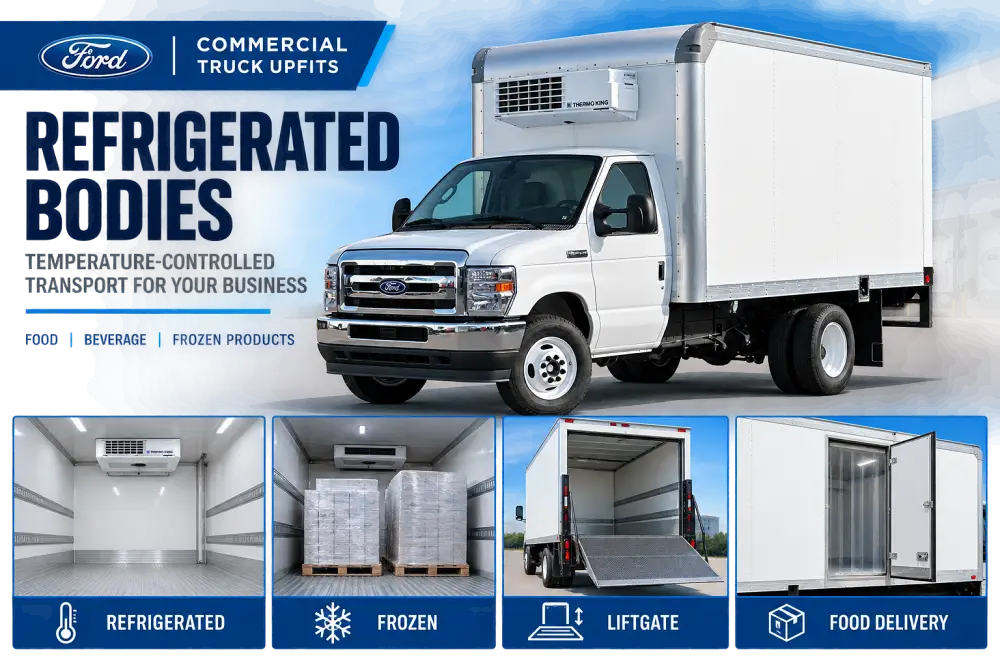
Refrigerated bodies combine an insulated cargo area with a refrigeration system designed to help maintain the required cargo environment while the truck is working.
We can help match the Ford chassis, refrigerated body, refrigeration equipment, doors, liftgate and other commercial equipment to your operation.
What Is a Refrigerated Body?
A refrigerated body is an insulated commercial cargo body equipped with a refrigeration system for transporting products that require temperature control.
These trucks are commonly used for food distribution, frozen products, refrigerated ingredients and other temperature-sensitive commercial cargo.
The body is designed to reduce heat transfer while the refrigeration system helps maintain the required cargo environment during transportation.
Body size, insulation, refrigeration capacity, door configuration and operating temperature should all be planned around what the business actually carries.
Designed for Temperature-Controlled Cargo
✓ Insulated cargo body
✓ Commercial refrigeration system
✓ Refrigerated or frozen applications
✓ Liftgate options
✓ Custom cargo access
What Are Refrigerated Trucks Used For?
Refrigerated trucks support businesses that need temperature-sensitive products delivered safely and consistently.
Food Distribution
Transport refrigerated food products between distributors, restaurants, stores and customers.
Frozen Products
Configure the truck for appropriate frozen-product transportation requirements.
Beverage Distribution
Support delivery of appropriate beverages and other temperature-sensitive products.
Temperature-Sensitive Cargo
Configure a refrigerated truck around specialized commercial cargo requirements.
Insulation Is a Critical Part of the Truck
A refrigerated truck body is built differently from a standard dry freight body because controlling heat transfer is essential to the application.
Insulated walls, roof, floor and doors help create a controlled cargo environment for the refrigeration system to maintain.
The required insulation and body construction depend on the temperatures, products and operating conditions of the business.
Built Around Temperature Control
✓ Insulated walls
✓ Insulated roof
✓ Insulated flooring
✓ Sealed cargo doors
✓ Washable interior options
Match the Refrigeration System to the Application
Refrigerated commercial trucks use dedicated refrigeration equipment designed around the size of the body and the temperature requirements of the cargo.
The refrigeration unit is typically visible on the exterior of the cargo body, while the complete system works with the insulated body to maintain the cargo environment.
The correct system depends on factors such as body size, outside temperature, desired cargo temperature, route length and how often doors are opened.
More Than Just Choosing a Cooling Unit
✓ Desired cargo temperature
✓ Body dimensions
✓ Route duration
✓ Door-opening frequency
✓ Southwest Florida operating temperatures
Refrigerated or Frozen Cargo?
The required cargo temperature can significantly affect the body insulation and refrigeration system.
Chilled Product Transport
Refrigerated applications are designed around products that need to remain within an appropriate chilled temperature range during transportation.
The exact temperature requirements depend on the products being transported.
Frozen Product Transport
Frozen applications generally require greater refrigeration capability and appropriate insulation for the intended operating conditions.
The truck should be specified around the actual product and required temperature range.
Choose the Right Refrigerated Body Size
Refrigerated bodies can be built in different dimensions depending on chassis, wheelbase, cargo requirements and body manufacturer.
A larger body provides more cargo volume, but it also adds body weight and increases the space the refrigeration system must manage.
The goal is to provide enough cargo capacity without adding unnecessary size or weight.
Start With What You Carry
✓ Product dimensions
✓ Product weight
✓ Required cargo volume
✓ Delivery route
✓ Loading method
Plan Doors Around the Delivery Route
Every time a refrigerated body is opened, outside air can enter the cargo area. Door configuration should support efficient loading while limiting unnecessary exposure.
Rear Cargo Doors
Provide primary access for loading larger quantities of refrigerated cargo.
Side Door
Side access can make frequent delivery stops more efficient when properly integrated with the body configuration.
Strip Curtains
Compatible interior strip curtains can help reduce air exchange during repeated cargo access.
Make Heavy Product Delivery Easier
A hydraulic liftgate can make loading and unloading refrigerated products much easier when the truck handles heavy cases, carts, equipment or palletized cargo.
The liftgate lowers to ground level and raises compatible cargo to the height of the cargo floor.
Liftgate weight and capacity must be included when planning the completed vehicle.
Improve Loading Efficiency
✓ Ground-level loading
✓ Hydraulic operation
✓ Multiple platform sizes
✓ Commercial delivery applications
Configure the Body Around Your Products
Insulated Interior
Body construction designed around the required temperature-controlled application.
Strip Curtains
Help reduce air exchange during frequent cargo access.
Cargo Control
Add compatible tie-down systems for products and equipment.
Interior Lighting
Improve cargo-area visibility during loading and deliveries.
Side Access
Add convenient access for frequent delivery stops.
Liftgates
Support loading and unloading of compatible heavy products.
Interior Dividers
Certain applications may use partitions to organize separate cargo zones.
Custom Equipment
Configure the body around the needs of the delivery operation.
Match the Refrigerated Body to the Right Ford Chassis
Refrigerated bodies and refrigeration equipment add significant weight, making proper chassis selection especially important.
Ford F-350
Can support appropriate refrigerated body applications when completed vehicle weight, payload and configuration remain within applicable ratings.
Explore F-350 Chassis Cab → F-450Ford F-450
A useful commercial chassis for refrigerated delivery applications requiring additional body and payload capability.
Explore F-450 Chassis Cab → F-550Ford F-550
Provides additional capability for heavier refrigerated bodies, liftgates, refrigeration systems and working cargo.
Explore F-550 Chassis Cab →Refrigeration Equipment Uses Payload Too
A refrigerated truck has more installed equipment than a standard dry freight truck.
The insulated body, refrigeration system, liftgate, driver, passengers, equipment and cargo all contribute to completed vehicle weight.
Chassis selection should be based on the complete working truck rather than only the empty body.
Account for the Complete Build
✓ Insulated body
✓ Refrigeration equipment
✓ Hydraulic liftgate
✓ Driver and passengers
✓ Product payload
Refrigerated Body or Dry Freight Body?
Temperature-Controlled Cargo
Designed for products that require an insulated cargo environment and refrigeration during transportation.
Non-Refrigerated Cargo
Designed for enclosed commercial cargo that does not require temperature-controlled transportation.
Explore Dry Freight Bodies →Built Around Commercial Delivery Routes
Refrigerated trucks are widely used by businesses that move temperature-sensitive food and beverage products throughout a local delivery area.
The best configuration depends on the number of daily stops, cargo size, product temperature, loading method and route length.
For businesses making frequent stops, door placement and cargo organization can be just as important as overall body size.
Think Beyond the Cargo Capacity
✓ Number of daily stops
✓ Door access
✓ Loading sequence
✓ Product temperature
✓ Route distance
Businesses That Use Refrigerated Trucks
Food Distributors
Transport appropriate chilled and frozen food products.
Restaurants
Support food supply movement between facilities and commercial locations.
Catering Companies
Transport temperature-sensitive products and supplies for events and commercial service.
Grocery Distribution
Deliver appropriate refrigerated and frozen products to retail locations.
Seafood Distribution
Configure trucks around temperature-sensitive seafood delivery requirements.
Bakery Distribution
Transport appropriate ingredients, products and commercial food supplies.
Delivery & Logistics
Support specialized temperature-controlled distribution routes.
More Industries
Explore commercial vehicles by business and industry.
View Industries →Hot Weather Makes Proper Refrigeration Planning Important
Southwest Florida’s warm climate can create demanding operating conditions for refrigerated commercial vehicles.
Body insulation, refrigeration capacity, door openings and route conditions should all be considered when planning the truck.
A refrigerated truck should be specified around the real operating conditions of the business rather than a generic body configuration.
Plan for the Actual Route
✓ High outside temperatures
✓ Frequent delivery stops
✓ Door-opening frequency
✓ Required product temperature
Need a Refrigerated Ford Commercial Truck?
We can help locate an available refrigerated truck or plan a chassis and refrigerated body around your business requirements.
Find a Work-Ready Refrigerated Truck
Tell us the body size, product type, temperature requirements and loading equipment your operation needs.
Configure Your Refrigerated Truck
Plan the chassis, insulated body, refrigeration system, access doors, liftgate and other equipment around the job.
How We Plan a Refrigerated Truck
Define the Cargo
Review what is being transported, product weight, volume and temperature requirements.
Select the Chassis
Match the Ford chassis to the completed refrigerated body and working payload.
Configure the Body
Determine body size, insulation, door locations and interior layout.
Add Refrigeration & Equipment
Match the refrigeration system, liftgate and other equipment to the application.
Standardize Your Refrigerated Truck Fleet
Businesses operating multiple refrigerated trucks can create a repeatable configuration for future vehicle replacements and additions.
Standardizing chassis, body dimensions, refrigeration equipment and loading systems can help create more consistent fleet operations.
Build Consistency Across the Fleet
✓ Same chassis configuration
✓ Same insulated body
✓ Same refrigeration system
✓ Same cargo access
✓ Easier replacement planning
Refrigerated Trucks in Southwest Florida
We help Southwest Florida businesses configure refrigerated Ford commercial trucks for food, beverage and temperature-sensitive cargo.
Build the Right Refrigerated Truck for Your Business
Tell us what products you transport, the temperature range you need, the amount of cargo you carry and how your routes normally operate.
We can help determine the Ford chassis, insulated body, refrigeration system, cargo access and loading equipment that make sense for your operation.
Prefer to talk? Call 239-274-2405
Frequently Asked Questions
What is a refrigerated truck?
A refrigerated truck is a commercial vehicle with an insulated cargo body and refrigeration system designed to transport products that require temperature control.
Can a refrigerated truck carry frozen products?
Refrigerated truck bodies can be configured for different temperature requirements, including appropriate frozen-product applications. The insulation and refrigeration system must be matched to the required operating temperature.
What Ford chassis can be used for refrigerated bodies?
Ford commercial chassis such as the F-350, F-450 and F-550 can support different refrigerated body configurations depending on body size, equipment, working cargo and completed vehicle weight.
Can a refrigerated truck have a hydraulic liftgate?
Yes. Compatible refrigerated truck configurations can be equipped with hydraulic liftgates to assist with loading and unloading heavy products.
Can a refrigerated body have a side door?
Many refrigerated body configurations can include side access doors. Door placement should be planned around the body design, insulation and delivery workflow.
What is the difference between a refrigerated body and a dry freight body?
A refrigerated body is insulated and uses refrigeration equipment for temperature-controlled cargo. A dry freight body provides enclosed cargo space for products that do not require active temperature control.
Does a refrigeration system reduce truck payload?
Refrigeration equipment, insulation, the body, liftgate and other installed equipment all add weight to the completed vehicle and therefore must be considered when determining available working payload.
Can I order a custom refrigerated Ford truck?
A refrigerated commercial truck can be planned around an appropriate Ford chassis and compatible refrigerated body, refrigeration system and equipment, subject to current availability and final engineering requirements.
Compare Other Commercial Cargo Bodies
Dry Freight Body
Enclosed cargo bodies for products that do not require refrigeration.
Explore →Box Truck
Explore complete enclosed commercial truck configurations.
Explore →Delivery Body
Commercial bodies designed around delivery routes and cargo access.
Explore →All Commercial Upfits
Compare service bodies, dump bodies, flatbeds and other work truck configurations.
View Upfits →Need a Refrigerated Truck for Your Business?
We can help match the Ford chassis, insulated body, refrigeration system, cargo access and loading equipment to your commercial operation.
Vehicle, refrigerated body, refrigeration system, liftgate, accessory and equipment availability, dimensions, operating temperature capability, payload, weight ratings and compatibility vary by configuration and manufacturer and can change. Refrigerated truck examples are provided for general planning purposes. Final chassis selection, refrigeration requirements, body specifications, payload, axle loading, completed vehicle weight and equipment compatibility should be verified before purchase, ordering or upfit installation.