Flatbed Trucks for Southwest Florida Businesses
Build a Ford F-350, F-450 or F-550 flatbed truck around the materials, equipment and cargo your business moves every day.
Flatbed trucks give crews open access from the sides and rear, making them one of the most flexible commercial truck configurations for contractors, equipment operators, landscapers and fleet customers.
We can help match the Ford chassis, cab style, flatbed length, payload needs, towing equipment and accessories to the way your truck will actually work.
What Is a Flatbed Truck?
A flatbed truck replaces a traditional pickup box with an open commercial platform designed to make loading, unloading and securing cargo easier.
Because there are no permanent pickup-box sides, crews can access cargo from multiple directions. Forklifts can load pallets from the side, long materials can extend across the bed and equipment can be positioned more easily.
Flatbeds can also be configured with headboards, stake pockets, toolboxes, tie-down points, gooseneck or fifth-wheel provisions, lighting and other commercial equipment.
This flexibility makes the flatbed one of the most useful body styles for businesses that carry changing loads instead of the same tools every day.
Built for Flexible Cargo
✓ Load from either side
✓ Easy forklift access
✓ Carry oversized materials
✓ Multiple body lengths
✓ Add toolboxes and storage
✓ Configure for towing
What Can a Flatbed Truck Carry?
Flatbeds are popular because the same truck can handle very different loads depending on what the business needs that day.
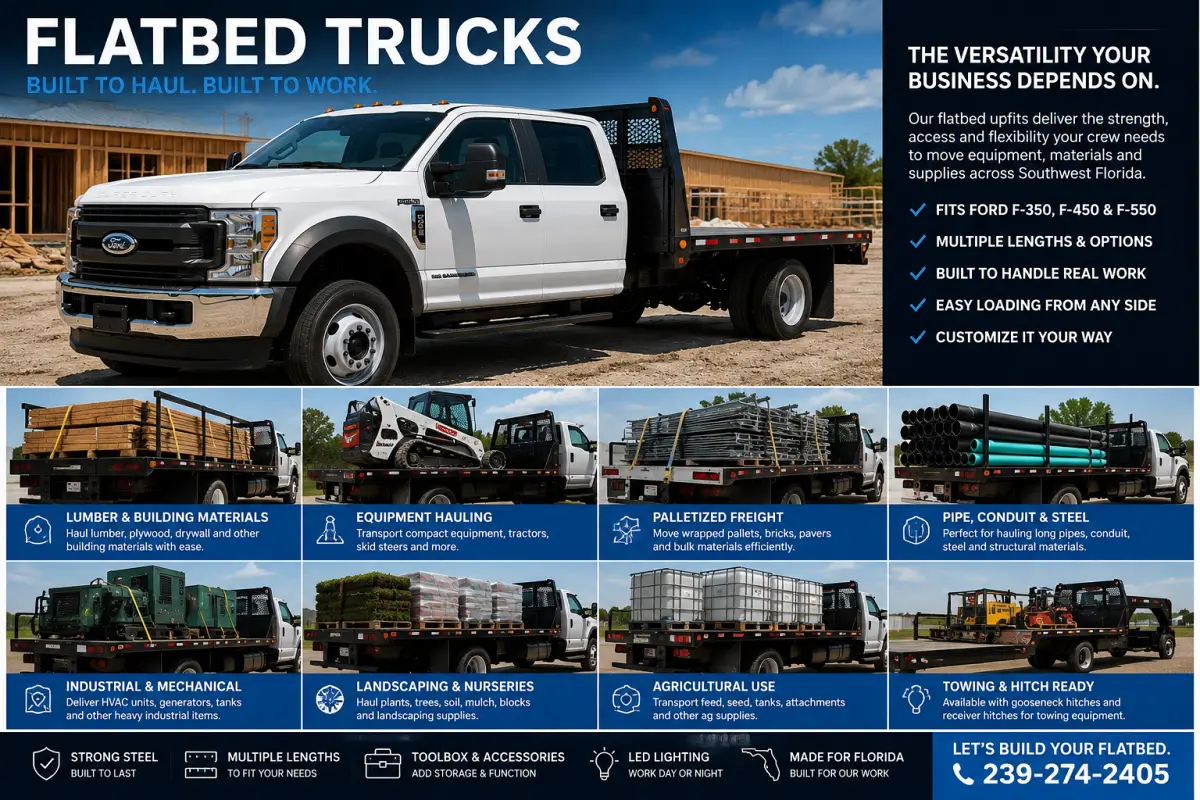
Lumber & Building Materials
Carry lumber, plywood, drywall, roofing materials, fencing and other building supplies to the jobsite.
Machinery & Equipment
Transport compact equipment, generators, pumps, tools and other commercial machinery.
Palletized Freight
Side access can make loading and unloading wrapped pallets, bricks, pavers and packaged materials easier.
Pipe, Conduit & Steel
Carry pipe, conduit, structural materials and other long commercial cargo.
Mechanical Equipment
Move HVAC units, tanks, compressors, industrial equipment and service components.
Plants & Landscape Supplies
Carry nursery materials, trees, sod, bagged products, blocks and landscaping supplies.
Farm & Agricultural Loads
Transport feed, seed, tanks, attachments, fencing supplies and other agricultural materials.
Trailers & Equipment
Certain flatbed configurations can support receiver, gooseneck or fifth-wheel towing when properly equipped.
F-350, F-450 or F-550: Which Flatbed Chassis Fits the Job?
The right chassis depends on the body, cargo, towing requirements and total completed vehicle weight.
Ford F-350 Flatbed
A strong option for businesses that need an open commercial bed without moving into the heavier chassis classes.
F-350 flatbeds can work well for building materials, equipment, contractors and general commercial hauling when the completed truck remains within its ratings.
Explore F-350 Chassis Cab → F-450Ford F-450 Flatbed
Provides additional chassis capacity for heavier bodies, equipment and commercial loads.
The F-450 can be a good middle ground for businesses that regularly carry heavier material or want additional capacity beyond an F-350.
Explore F-450 Chassis Cab → F-550Ford F-550 Flatbed
A heavier commercial platform for larger bodies, equipment loads, towing requirements and demanding vocational applications.
F-550 flatbeds are especially useful when the business needs more chassis capacity for the completed truck and its working load.
Explore F-550 Chassis Cab →Crew Cab Flatbed Trucks
For businesses that regularly send several employees to the same jobsite, a crew cab flatbed can combine passenger space with the flexibility of a commercial open bed.
This configuration can work well for contractors, construction crews, utilities, landscape companies and businesses that need the same vehicle to move both employees and materials.
Cab selection should be considered together with wheelbase, body length and payload because a larger cab changes the overall chassis configuration.
One Truck for People and Cargo
✓ Carry multiple employees
✓ Open commercial cargo bed
✓ Useful for jobsite crews
✓ Available on multiple chassis configurations
✓ Can be customized around the trade
Choose the Right Flatbed Length
Flatbeds are available in different lengths, and the correct body must be matched to the chassis wheelbase and cab-to-axle dimension.
Maneuverability
A shorter flatbed can provide useful cargo space while keeping the overall truck easier to maneuver in tighter commercial environments.
Balanced Utility
Mid-length bodies can provide a useful balance between cargo capacity, wheelbase and everyday maneuverability.
More Deck Space
Longer flatbeds can provide additional room for pallets, materials and equipment when the chassis is configured for the body length.
Customize the Flatbed Around Your Business
The body can be configured with equipment that makes loading, storage, towing and daily work easier.
Headboard
Provides a barrier between the cab and cargo area and can support additional body functions.
Stake Pockets
Allow removable sides or other body accessories to be added when the application requires them.
Underbody Toolboxes
Add secure storage beneath the deck without using valuable flatbed cargo space.
Topside Toolboxes
Provide additional accessible storage for tools, straps, chains and jobsite equipment.
Tie-Down Points
Help secure materials and equipment during transport when used with appropriate load-securing equipment.
LED Work Lighting
Improve visibility around the truck during early-morning, evening and low-light work.
Receiver Hitch
Add conventional trailer capability when the completed vehicle is properly equipped.
Gooseneck or Fifth-Wheel
Certain flatbeds can be configured around in-bed towing equipment when properly designed and matched to the chassis.
Build a Flatbed Around Your Trailer Needs
Many businesses use their flatbed for both cargo and trailer towing. Planning those requirements together can help determine the correct chassis, hitch configuration and body.
Conventional receiver towing, gooseneck and fifth-wheel applications can place different demands on the truck.
Trailer weight, tongue or pin weight, cargo, passengers, body weight and equipment all need to be considered as part of the completed vehicle.
Consider the Whole Combination
✓ Trailer type
✓ Loaded trailer weight
✓ Hitch type
✓ Flatbed and accessory weight
✓ Cargo and equipment
✓ Chassis ratings
The Flatbed Is Only Part of the Payload
One of the most important parts of building a flatbed is understanding what the completed truck will weigh before it starts carrying cargo.
The chassis, flatbed, toolboxes, hitch equipment, fuel, passengers and accessories all use available vehicle capacity before materials or equipment are loaded.
Planning the complete vehicle helps determine whether an F-350, F-450 or F-550 is the better fit for the expected working load.
Account for the Full Working Load
✓ Flatbed body
✓ Toolboxes
✓ Hitch equipment
✓ Driver and passengers
✓ Tools and equipment
✓ Working cargo
Is a Flatbed the Right Upfit?
The best body depends on whether your priority is open cargo access, enclosed storage, removable sides or dumping capability.
Maximum Open Access
Best when crews need open side and rear access for changing materials, pallets and equipment.
Commercial Platform
Another open commercial body configuration that can be tailored around cargo and equipment.
Explore Platform Bodies → STAKE BEDRemovable Side Panels
Adds side containment while preserving the flexibility of an open commercial platform.
Explore Stake Beds → DUMP BODYUnload Bulk Material
Designed for businesses that need to transport and hydraulically unload loose material.
Explore Dump Bodies →Businesses That Use Flatbed Trucks
Flatbeds work well for businesses that regularly move materials, equipment or cargo that changes from one job to the next.
General Contractors
Move tools, lumber, equipment and building materials between jobsites.
Roofing Companies
Transport roofing materials, tools and equipment to residential and commercial projects.
Landscaping Companies
Carry plants, trees, materials, equipment and landscape supplies.
Electrical Contractors
Carry conduit, equipment, electrical materials and large installation components.
Plumbing Companies
Transport pipe, fittings, equipment and jobsite materials.
Equipment Companies
Move machinery, attachments, generators and commercial equipment.
Government & Municipal
Support public works, maintenance and utility operations with flexible hauling capability.
More Industries
Explore commercial vehicle and upfit solutions organized around different business applications.
View Industries →Need a Flatbed Truck Now or Want to Build One?
We can help you find an available commercial flatbed or configure a Ford chassis and flatbed around your exact business requirements.
Find a Work-Ready Truck
Tell us the chassis, cab, bed length and payload requirements you need. We can help determine whether an available truck fits the job.
Build the Truck Around the Work
Need a specific body length, toolbox layout, towing system or chassis configuration? We can help plan the entire truck.
How We Build the Right Flatbed Truck
Define the Load
Determine what the truck will carry, how much it weighs and how crews load and unload it.
Select the Chassis
Match the F-350, F-450 or F-550 chassis to the expected completed vehicle and working load.
Choose the Flatbed
Match body length, deck design, storage, tie-downs and towing equipment to the application.
Coordinate the Upfit
Coordinate the chassis and body so the completed truck is configured for its commercial use.
Standardize Flatbeds Across Your Fleet
Businesses operating several flatbed trucks can create a repeatable chassis and body specification instead of building every truck differently.
Standardizing body length, toolboxes, lighting, hitch equipment and tie-down locations can make trucks easier for employees to use.
It can also make future replacement and fleet expansion easier to plan.
Keep the Fleet Consistent
✓ Same chassis configuration
✓ Same flatbed length
✓ Same toolbox layout
✓ Same towing equipment
✓ Same lighting and tie-downs
✓ Easier replacement planning
Flatbed Trucks in Southwest Florida
We help businesses throughout Southwest Florida find and configure Ford F-350, F-450 and F-550 flatbed trucks for commercial and fleet use.
Find or Build the Right Flatbed Truck
Tell us what you carry, how much weight the truck needs to handle, how many employees need to ride in it and whether you tow a trailer.
We can help determine whether an F-350, F-450 or F-550 makes the most sense, then help with the flatbed body, equipment, available inventory or factory ordering.
Prefer to talk? Call 239-274-2405
Frequently Asked Questions
What is a flatbed truck?
A flatbed truck uses an open commercial platform instead of a traditional pickup bed. This provides easier access from the sides and rear for loading materials and equipment.
Can I put a flatbed on a Ford F-350?
Yes. Certain Ford F-350 commercial chassis configurations can be equipped with flatbed bodies when the chassis, body and completed vehicle weight are properly matched.
What is the difference between an F-350, F-450 and F-550 flatbed?
The primary differences involve chassis capacity and available configurations. The appropriate truck depends on flatbed weight, equipment, cargo, towing needs and the expected completed vehicle load.
Can I get a crew cab flatbed truck?
Yes. Crew cab flatbed configurations can be useful for businesses that need to carry multiple employees along with materials or equipment.
Can a forklift load a flatbed from the side?
One of the main advantages of an open flatbed is side access. Depending on the cargo and body configuration, this can make forklift loading and unloading easier.
Can a flatbed truck tow a gooseneck trailer?
Certain flatbed and chassis configurations can be designed for gooseneck towing when properly equipped. Trailer weight, hitch design, body configuration and vehicle ratings must all be considered.
Can toolboxes be added to a flatbed?
Yes. Underbody and topside toolboxes can provide secure storage for tools, straps, chains and commercial equipment.
Can I factory order a Ford truck for a flatbed upfit?
A Ford commercial chassis can often be ordered around planned cab, wheelbase, body length and capacity requirements. The planned flatbed should be considered before selecting the final chassis configuration.
Explore Other Open & Material-Hauling Bodies
Platform Body
Open commercial platform configurations for materials and equipment.
Explore →Stake Bed
Open platform with removable side panels for flexible commercial hauling.
Explore →Dump Body
Hydraulic dumping capability for loose construction and landscape materials.
Explore →Contractor Body
Combines tool compartments, open cargo space and racks for jobsite materials.
Explore →Need an F-350, F-450 or F-550 Flatbed?
We can help you choose the Ford chassis, cab, body length, towing equipment, toolboxes and flatbed configuration that fits your business.
Vehicle, flatbed, towing equipment and accessory availability, dimensions, weight ratings and compatibility vary by configuration and manufacturer and can change. Commercial upfit examples are provided for general planning purposes. Final chassis selection, payload, axle loading, body length, hitch compatibility, towing capacity and completed vehicle specifications should be verified before purchase, ordering or upfit installation.